Few areas of cybersecurity generate as much acronym confusion as detection and response. Vendors use EDR, XDR, and MDR in overlapping and sometimes contradictory ways, and buyers are often left comparing options that are not actually alternatives to one another. The key to clarity is a single distinction: two of these terms describe technology, and one describes a service. Once that is clear, the decision becomes a question of coverage and capacity rather than of competing products. This article explains each term, how they relate, where SIEM fits, and how to decide what your organization needs.
The short answer
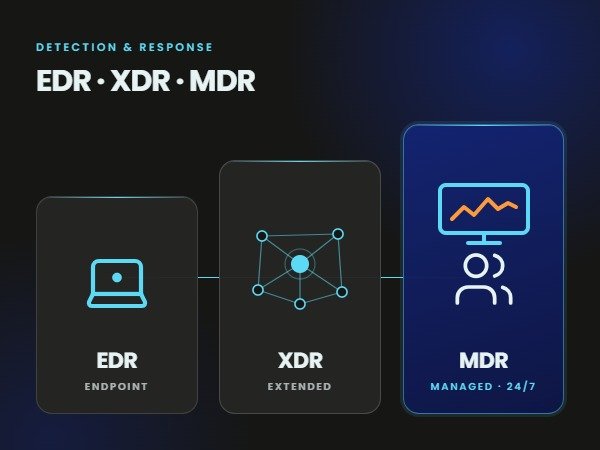
EDR watches your endpoints. XDR watches your endpoints and much more, connecting what it sees across identity, email, network, and cloud. MDR is a team that watches whatever technology you have, investigates what it finds, and responds.
That is why “EDR or MDR” is often the wrong question. Most MDR services run on top of an EDR or XDR platform. The real questions are how much of your environment you need to see, and whether you have the people to act on what you see at any hour of the day.
EDR: deep visibility on the endpoint
Endpoint Detection and Response emerged because traditional antivirus, which relied on recognizing known malicious files, could not keep up with modern attacks. Attackers increasingly use legitimate tools already present on a system, steal credentials, and avoid dropping recognizable malware at all. EDR addresses this by recording detailed activity on each endpoint, such as processes, file changes, network connections, and user behavior, and by analyzing that activity for patterns that indicate an attack.
EDR delivers three core capabilities:
- Visibility: a continuous record of what happens on every protected device, which investigators can search after the fact.
- Detection: behavioral analytics that flag suspicious activity even when no known malware is involved.
- Response: the ability to act directly on the endpoint, for example isolating a compromised machine from the network or stopping a malicious process.
EDR is the foundation of modern detection, because the endpoint is where most attacks eventually execute. Its limitation is scope. EDR sees the device, but it does not see a suspicious login to a cloud application, a malicious email that has not been opened yet, or unusual traffic between two servers it does not protect. Attacks rarely stay on a single endpoint, and an investigation that can only see endpoints sees part of the story.
XDR: correlation across the whole environment
Extended Detection and Response was created to close that scope gap. XDR collects telemetry from several security layers, typically endpoints, identity, email, network, and cloud workloads, and correlates it. Instead of five separate tools raising five separate alerts about what is actually one attack, XDR connects the events into a single incident with a clear timeline.
The value of XDR comes from that correlation. A phishing email, a credential used from an unusual location an hour later, and a new process on a server the next morning are each weak signals on their own. Together they describe an intrusion in progress. XDR makes that connection automatically and lets responders act across layers, for example by disabling a compromised account and isolating the affected endpoint from the same console.
XDR comes in two broad flavors. Native XDR is built around a single vendor’s own products, which tends to integrate deeply but can lock the organization into one ecosystem. Open XDR ingests data from tools made by different vendors, which preserves existing investments but depends on the quality of each integration. Neither is universally better. The right choice depends on how consolidated the existing security stack already is.
What XDR does not do is staff itself. It produces better, more consolidated detections than EDR, but those detections still need someone to investigate them, decide what is real, and respond, including at three in the morning on a holiday.
MDR: the service that operates the technology
Managed Detection and Response is not a product category. It is a service. An MDR provider supplies a team of analysts who monitor your environment continuously, investigate alerts, hunt for threats that evaded automated detection, and respond to confirmed incidents, usually within defined service levels.
MDR exists because technology alone does not stop attacks. Someone has to triage the alerts, separate real threats from noise, and act fast enough to matter. Building that capability internally requires a team large enough to cover every hour of every day, plus the expertise to investigate complex incidents, and most organizations cannot hire or retain that team.
MDR services typically operate an EDR or XDR platform, either one the provider brings or one the client already owns. The service is defined less by the tool and more by its outcomes: how quickly threats are detected, how thoroughly they are investigated, and whether the provider actually responds or simply forwards alerts back to the client. MDR is closely related to a managed SOC, and in practice a managed SOC usually includes MDR-grade detection and response as part of a broader monitoring scope.
EDR vs XDR vs MDR side by side
The table below summarizes the three across the dimensions that matter most when making a decision.
| Dimension | EDR | XDR | MDR |
|---|---|---|---|
| What it is | Technology | Technology | Managed service |
| Coverage | Endpoints only | Endpoints, identity, email, network, cloud | Whatever the operated technology covers |
| Main output | Endpoint alerts and response actions | Correlated incidents across layers | Investigated and contained threats |
| Who operates it | Your team | Your team | The provider's analysts, 24/7 |
| Threat hunting | Possible, if your team does it | Possible, if your team does it | Included in the service |
| Best for | Organizations with an analyst team focused on endpoints | Organizations with a capable team and a broad attack surface | Organizations that need outcomes without building a 24/7 team |
The row that decides most purchases is “who operates it”. EDR and XDR assume you have people. MDR assumes you may not.
Where SIEM fits in this picture
SIEM is often added to this comparison, and it plays a related but distinct role. A SIEM aggregates logs from across the environment, supports compliance and long-term retention, and runs correlation rules over very diverse data sources. XDR overlaps with SIEM in correlation, but it is generally more focused on high-quality security telemetry and on response, while SIEM is broader and more log-centric. Many mature environments use both. Like EDR and XDR, a SIEM is technology that still needs a team to operate it, which is exactly the difference between a SIEM and a managed SOC.
Two newer acronyms complete the landscape. NDR (Network Detection and Response) focuses on network traffic, and ITDR (Identity Threat Detection and Response) focuses on identity systems and credential abuse. Both are often absorbed as data sources into an XDR or operated as part of an MDR service.
How AI changes detection and response
The biggest operational bottleneck across EDR, XDR, and SIEM has always been the same: there are more alerts than people to investigate them. This is where artificial intelligence now investigates alerts the way a skilled analyst would, gathering context from the endpoint, identity, and cloud data, correlating it, and reaching a verdict in minutes rather than leaving the alert in a queue.
For MDR in particular, AI changes the economics. A service that combines AI-driven triage with human experts can cover more data, respond faster, and keep its analysts focused on complex investigations and threat hunting instead of repetitive triage. When evaluating an MDR provider, the question is no longer only how many analysts it has, but how intelligently it uses automation to reduce the time from alert to containment.
Which one does your company need?
The decision follows from two questions: how much of your environment needs to be visible, and who will act on what you see.
- If you have a strong internal team and a mostly endpoint-centric environment, EDR operated by your own analysts may be enough, provided someone covers nights and weekends.
- If your environment spans cloud, identity, email, and many integrations, XDR gives you the correlated view that endpoint-only tools cannot, but only if your team has the capacity to investigate what it surfaces.
- If you cannot staff detection and response around the clock, MDR is the path to real outcomes, and it typically includes or operates EDR or XDR technology as part of the service.
- If you already own EDR or XDR but alerts go uninvestigated, MDR is how you finally extract value from that investment rather than replacing it.
For most mid-sized organizations, the honest answer is a combination: EDR or XDR as the technology layer, operated through an MDR or managed SOC service.
Common mistakes when choosing
Three mistakes appear again and again. The first is buying XDR to “upgrade” from EDR without adding the people to operate it, which produces better alerts that still go unanswered. The second is choosing an MDR provider on price alone without checking whether it actually responds or merely notifies, which leaves the hardest part of the work with the client. The third is never testing the result. Detection that has never faced a realistic attack is an assumption, and a Red Team engagement is the most direct way to confirm that the technology and the team detect what they are supposed to detect.
How Mercurius approaches detection and response
Mercurius delivers detection and response as an outcome, not a tool handoff. Its AI-native SOC operates EDR and XDR-class technology on the client’s behalf, whether the client already owns a platform or needs one, with AI carrying the continuous triage and certified specialists handling investigation, threat hunting, and containment around the clock.
Because the team also runs offensive security, detection is validated against how real attackers operate, not only against vendor defaults. The goal is the same in every engagement: shorter time to detect, shorter time to contain, and clear visibility for the client into what happened and why.
Frequently asked questions
What is the main difference between EDR and XDR?
EDR monitors and responds on endpoints only. XDR collects and correlates telemetry across several layers, such as identity, email, network, and cloud, connecting separate signals into a single incident. XDR offers broader context, while EDR offers deep visibility on devices.
Is MDR a replacement for EDR?
No. MDR is a service, and it usually runs on top of EDR or XDR technology. Instead of replacing the tool, MDR provides the analysts who monitor it, investigate alerts, hunt for threats, and respond around the clock.
Do I need XDR if I already have a SIEM?
Possibly. SIEM is broader and more log-centric, while XDR is more focused on high-quality security telemetry and response across layers. Many organizations use both. The more important question is whether a team is operating them continuously.
What is the difference between MDR and a managed SOC?
MDR focuses specifically on detecting and responding to threats, typically centered on endpoint and related telemetry. A managed SOC usually covers a broader monitoring scope. In practice the two overlap heavily, and a strong managed SOC includes MDR-grade detection and response.
Is MDR suitable for mid-sized companies?
Yes, and it is often the most practical option for them. Mid-sized organizations face the same threats as large ones but rarely have the budget to staff a 24/7 detection team, which is exactly the gap MDR is designed to fill.