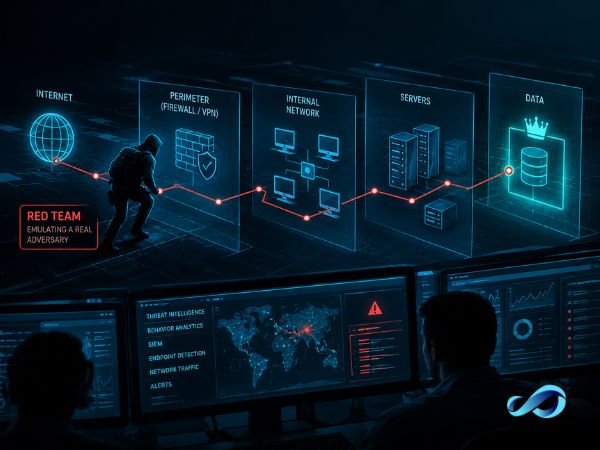
Most security investments are validated in isolation. A firewall is configured, an endpoint protection tool is deployed, a monitoring service is contracted, and each one is assumed to work. A Red Team answers the question that isolated tests cannot: when a capable adversary targets your organization, does everything work together, and does it work in time? This article explains what a Red Team is, how an engagement unfolds, how it relates to blue and purple teams, what needs to be in place before running one, and what a useful result looks like. If you are still deciding between exercises, it helps to first understand how a pentest and a Red Team engagement differ.
The short answer
A Red Team is controlled adversary emulation. A team of specialists receives a business objective, such as reaching a payments database or obtaining privileged access to a critical system, and attempts to achieve it the way a real threat actor would, while the defenders go about their normal work. The outcome is not only whether the objective was reached, but where the attack was noticed, how quickly, and how the organization responded. It is a test of people, process, and technology at the same time.
That is the essential difference in mindset. A vulnerability assessment asks what is broken. A Red Team asks what an adversary could actually accomplish, and whether anyone would stop them.
Why organizations run a Red Team
Real attacks rarely depend on a single dramatic flaw. They chain together small weaknesses: a credential exposed here, an overly broad permission there, an alert that fired but was never investigated. Each of those weaknesses may look minor in a report. Combined, they become a path to the most sensitive assets in the company. A Red Team is designed to find those paths, because it thinks in chains rather than in isolated findings.
Organizations run Red Team engagements for four main reasons:
- To measure detection and response, not just prevention. Prevention will eventually fail somewhere. What matters is whether the defense notices and reacts before the attacker reaches the objective.
- To validate security investments. Tools and services are expensive. A Red Team shows whether they deliver in a realistic scenario or only on paper.
- To give the board honest evidence. A statement such as “an emulated adversary reached the objective in nine days and was detected on day seven” communicates risk far more clearly than a count of vulnerabilities.
To train the defense under realistic pressure. The blue team learns more from one well-run engagement than from many scripted drills, because the adversary does not follow a script.
The phases of a Red Team engagement
Every engagement is tailored, but most follow a recognizable sequence. The phases below describe the structure at a conceptual level, and in practice each is mapped to the tactics catalogued in the MITRE ATT&CK framework, which gives the exercise and its report a common language.
- Scoping and threat modeling. Sponsors define the objective, the constraints, and the rules of engagement: what is allowed, what is off limits, and how business operations are protected. The scenario is built from threat intelligence about the actors that realistically target the sector, so the exercise reflects a credible adversary rather than a generic one.
- The team studies the organization from the outside, as an adversary would, mapping its public footprint, exposed services, and the people and roles that matter to the objective.
- Initial access. The team attempts to gain a first foothold through routes that are realistic for the chosen threat actor. Depending on what was authorized, this can involve technical weaknesses or controlled social engineering.
- Progression toward the objective. From the foothold, the team works toward the target while trying to remain undetected. This is the phase that most directly tests monitoring, because it reveals whether unusual behavior inside the environment is noticed and investigated.
- Demonstrating the objective. The team proves it reached the target using controlled evidence, never by causing real damage or removing real data.
- Reporting and debrief. The Red Team’s timeline of actions is compared with what the defenders observed. The gaps between the two are the most valuable output of the entire exercise.
Throughout the engagement, a small control group monitors safety and can pause activity at any moment if business operations are at risk.
Red team, blue team, purple team, and white team
The color names describe roles, and understanding them clarifies how an engagement is organized and how its value is extracted afterwards.
| Team | Role | Mindset |
|---|---|---|
| Red team | Emulates the adversary and attempts to reach the objective | Offensive |
| Blue team | Monitors, detects, and responds to threats as part of normal operations | Defensive |
| Purple team | Red and blue work together openly to tune and improve detection | Collaborative |
| White team | Small control group that oversees safety and the rules of engagement | Governance |
The purple team deserves special attention. After a Red Team engagement reveals where detection failed, a purple team session brings both sides to the same table. The red team replays specific techniques while the blue team watches its own tools, adjusts detection rules, and confirms that the gap is closed. It is the fastest way to convert Red Team findings into lasting improvement, and many mature programs alternate between the two formats.
Is your organization ready for a Red Team?
A Red Team produces value only when there is a defense capable of being tested. Running one too early is a common and expensive mistake: the team reaches the objective easily, the report confirms what everyone already suspected, and the budget would have been better spent elsewhere. Before commissioning a Red Team, an organization should be able to answer yes to most of these questions:
- Is technical risk under control? You run a penetration test regularly and the critical findings from previous tests have been fixed.
- Is there continuous monitoring? A detection capability exists, whether an internal team or a managed SOC, watching the environment around the clock.
- Is there an incident response process? The organization knows who acts, who decides, and who communicates when a real incident is confirmed.
- Is there executive sponsorship? Leadership accepts that the exercise may succeed and treats the result as a learning tool, not as a failure to be hidden.
If several of these answers are no, the better path is to strengthen the foundations first. A mature provider will say so openly rather than sell an exercise the organization is not ready to benefit from.
What a useful Red Team report delivers
The report is where the engagement turns into decisions, and its quality varies enormously between providers. A useful Red Team report contains:
- An attack narrative and timeline. The path the team took, step by step, with the time each stage required.
- A detection map. For each stage, whether the defense noticed, how long it took, and what response followed. This is the core of the report.
- A MITRE ATT&CK mapping. Techniques used, linked to the framework, so detection gaps can be prioritized and tracked over time.
- Prioritized recommendations. Improvements ranked by how much they would have shortened or blocked the attack path, not by generic severity.
- An executive summary. The result explained in business terms for leadership and the board.
What a Red Team report is not: a long list of vulnerabilities copied from a scanner. If the deliverable looks like that, the exercise was a vulnerability assessment with a different name.
Threat-led testing in regulated sectors
Red Team methodology has gained formal recognition in heavily regulated industries, especially financial services. In Europe, the TIBER-EU framework established a standard for threat-led red teaming built on intelligence about real adversaries, and the Digital Operational Resilience Act (DORA) requires threat-led penetration testing (TLPT) for significant financial entities. In the United Kingdom, the CBEST framework plays a similar role for systemically important institutions.
The common principle across these frameworks is that the scenario must be grounded in threat intelligence specific to the institution and that the exercise must test detection and response, not only prevention. Even where regulation does not yet require it, these frameworks have become the reference for what a serious Red Team engagement looks like, and organizations in Latin America increasingly use them as a benchmark for resilience testing.
How Mercurius runs Red Team engagements
Mercurius runs Red Team engagements as threat-led adversary emulation, carried out by certified offensive engineers (OSCP, CRTO, among other credentials) who think like the attacker in order to protect like a strategist. Each scenario is built from intelligence about the actors that target the client’s sector, executed under strict rules of engagement with a white team overseeing safety, and mapped to MITRE ATT&CK from planning to report.
The deliverable centers on the detection map and the executive narrative, so both the technical team and the board understand what happened and what to fix first. When the findings call for it, the engagement continues with purple team sessions to close detection gaps alongside the client’s defenders. And when an organization is not yet ready for a Red Team, the recommendation is to strengthen the foundations first, because the goal is resilience, not a more impressive report.
Frequently asked questions
What is the difference between a Red Team and a pentest?
A pentest searches for as many exploitable vulnerabilities as possible within a defined scope and time frame, usually with the defense team aware. A Red Team pursues a specific objective, emulates a real adversary, and operates without warning the defenders, in order to test detection and response. One measures how vulnerable you are, the other measures how resilient you are.
How long does a Red Team engagement last?
Typically several weeks to a few months. Reconnaissance, stealthy progression, and the need to avoid detection all take time, and the exercise must run long enough to reflect how a patient adversary actually behaves.
Does the security team know the exercise is happening?
No. Only a small control group, the white team, is informed. Keeping the blue team unaware is what allows the exercise to measure real detection and response. After the engagement, the results are shared openly with the defenders.
Is a Red Team engagement safe for production systems?
When run professionally, yes. The rules of engagement define what is off limits, the white team can pause the exercise at any moment, and objectives are demonstrated with controlled evidence rather than real damage or data removal.
What is purple teaming?
Purple teaming is a collaborative exercise in which the red and blue teams work together openly. The red team replays specific techniques while the blue team tunes its detection in real time. It is the most efficient way to turn Red Team findings into lasting improvements.