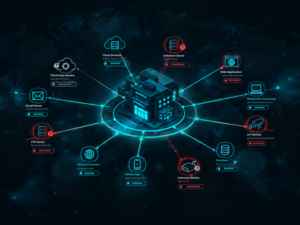
No modern company operates alone. Payroll runs on a SaaS platform, customer data sits with a cloud provider, an agency manages the website, and a support partner has remote access to internal systems. Each of these relationships brings efficiency, and each one extends the organization’s attack surface to infrastructure it does not control. Third-party risk management is the discipline that keeps that extension under control. This article explains why third parties matter so much for security, the lifecycle of a TPRM program, how to tier and assess vendors, which contract clauses make a difference, and how to move from a yearly questionnaire to continuous oversight.
The short answer
TPRM answers one question for every vendor: how much risk does this relationship bring, and is it being managed? A good program does not treat all suppliers equally. It identifies which vendors are critical, assesses them with the depth their access justifies, writes security expectations into contracts, and keeps watching after the contract is signed.
The most important shift is from point in time to continuous. A questionnaire answered once a year describes a vendor’s intentions on a single day. Real oversight requires signals that keep arriving between those reviews.
Why third parties became a security risk
Attackers follow the path of least resistance. When a target is well defended, a smaller supplier with legitimate access to that target is often the easier way in. A compromised managed service provider, a vulnerable software update, or a leaked vendor credential can bypass controls that the organization spent years building. For the attacker, one supplier can be a door into many customers at once.
Regulation reflects this reality. Frameworks such as ISO 27001 include supplier relationships among their controls, data protection laws such as the LGPD make organizations accountable for how their processors handle personal data, and regulators of financial institutions increasingly require formal oversight of technology providers, as the European DORA does explicitly. The common message is clear: outsourcing a service does not outsource the responsibility for its risk.
There is also an internal motivation that is often underestimated. Preparing for certification forces an organization to know its assets, assign owners, assess risks consistently, and define responsibilities. Many leaders report that this clarity is as valuable as the certificate itself.
What counts as a third party
The term covers more than traditional suppliers. A complete inventory usually includes:
- Technology and SaaS providers that store or process company data.
- Cloud and infrastructure providers that host systems and workloads.
- Managed service providers with administrative or remote access.
- Agencies and consultants that manage websites, marketing tools, or customer data.
- Business process outsourcers such as payroll, collections, or customer support.
- Software vendors whose code runs inside the environment.
- Fourth parties, the subcontractors of your vendors, which inherit part of the same risk.
A useful test is simple: if a company has access to your data, your systems, or your network, or if your operation stops when it stops, it belongs in the TPRM program.
The TPRM lifecycle
A mature program manages each vendor through a repeatable lifecycle.
- Identify every third party, who owns the relationship internally, and what each one accesses. Many organizations discover vendors that procurement never registered.
- Classify vendors by risk, based on the sensitivity of the data they handle, the level of access they hold, and how critical they are to operations.
- Evaluate the vendor’s security with a depth proportional to its tier, before the contract is signed.
- Translate security expectations into contractual obligations.
- Continuous monitoring. Track changes in the vendor’s security posture, incidents, and exposures throughout the relationship.
- When the relationship ends, revoke access, recover or confirm deletion of data, and close accounts.
Offboarding is the most neglected stage. Former vendors with active credentials or retained data are a quiet but very real source of exposure.
How to tier vendors by risk
Tiering is what keeps TPRM practical. Applying the same deep assessment to every supplier exhausts the team and frustrates the business, while applying a light review to critical vendors leaves the largest risks unexamined. A common model uses three tiers.
| Tier | Typical vendors | Assessment depth | Review frequency |
|---|---|---|---|
| Critical | Vendors with privileged access, sensitive data, or operations that stop if they fail | Detailed questionnaire, evidence review, certifications, and technical validation | Continuous monitoring plus a full review every year |
| Moderate | Vendors with limited data or system access | Standard questionnaire and review of certifications | Continuous monitoring plus a review every one to two years |
| Low | Vendors with no access to data or systems | Basic due diligence at onboarding | Review at renewal or when the scope changes |
The tier is not permanent. A vendor that starts with a narrow scope and later receives access to customer data should move up, which is why scope changes must trigger a new classification.
How to assess a vendor
A strong assessment combines several sources of evidence rather than relying on a single self-declaration.
- Security questionnaires. Structured questions about policies, access control, encryption, incident response, and business continuity, scaled to the vendor’s tier.
- Certifications and reports. Recognized certifications such as ISO 27001 or independent reports such as SOC 2 provide external evidence that controls exist and are audited. They should be checked for scope, because a certificate covering a different business unit does not cover the service being purchased.
- Supporting evidence. For critical vendors, documents such as recent penetration test summaries, incident response plans, and business continuity tests show whether stated controls work in practice.
- External posture. An outside-in view of the vendor’s exposed assets, such as outdated internet-facing systems or leaked credentials, adds an independent signal that does not depend on what the vendor reports.
- Fourth-party review. For critical services, understanding which subcontractors the vendor depends on reveals concentration risks that would otherwise stay hidden.
The goal is not to collect the most documents. It is to reach a justified decision: accept the vendor, accept it with remediation requirements, or reject it.
Contract clauses that matter
The contract is where expectations become enforceable. The clauses that most often make a difference are:
- Security requirements describing the minimum controls the vendor must maintain.
- Incident notification with a defined deadline for informing the organization of security incidents that may affect it.
- Right to audit or to request evidence of compliance.
- Data handling and protection, including where data is stored, how it is protected, and the obligations of a data processing agreement under laws such as the LGPD.
- Subcontracting rules requiring approval or notification before fourth parties gain access.
- Exit provisions covering the return or deletion of data and the revocation of access when the relationship ends.
Negotiating these clauses before signature is far easier than adding them later, which is why security must take part in procurement rather than review vendors after the fact.
Continuous monitoring: beyond the annual questionnaire
The weakness of traditional TPRM is timing. A vendor that passed its assessment in March can suffer a breach in June, expose a vulnerable system in August, or lose its security lead in October, and none of that appears until the next questionnaire.
Continuous monitoring closes that gap with signals that arrive between reviews. An outside view of each critical vendor’s external attack surface reveals new exposures as they appear. Threat intelligence can detect leaked vendor credentials, mentions in criminal forums, and public incident reports. Changes in certifications, ownership, or scope can trigger an early reassessment. Together, these signals turn TPRM from a compliance ritual into an early warning system.
Common mistakes in TPRM programs
Several mistakes appear in organizations of every size:
- Treating all vendors the same, which overloads the team and dilutes attention on critical suppliers.
- Relying only on self-assessments, accepting questionnaire answers without evidence or independent verification.
- Checking certifications without checking scope.
- Stopping at onboarding, with no monitoring after the contract is signed.
- Ignoring offboarding, leaving former vendors with active access or retained data.
- Keeping security out of procurement, so contracts are signed before risks are assessed.
How to scale TPRM without spreadsheets
Most TPRM programs start in spreadsheets and email, and most of them stall there. Questionnaires get lost, evidence expires unnoticed, and nobody knows which vendors are overdue for review. As the number of suppliers grows, manual tracking becomes the bottleneck.
Compliance automation platforms address this by centralizing the vendor inventory, sending and tracking questionnaires, storing evidence with expiration dates, scoring risk consistently, and alerting the team when a review is due or a vendor’s status changes. Automation does not replace judgment about risk, but it removes the administrative load that keeps most teams from exercising that judgment at all.
How Mercurius supports third-party risk management
Mercurius supports TPRM by combining governance with offensive and defensive security. On the governance side, it helps organizations build the vendor inventory, define tiering criteria, design questionnaires and contract requirements, and run the program on compliance automation, so reviews and evidence are tracked continuously instead of manually.
On the technical side, Mercurius adds what questionnaires alone cannot provide: an independent view of critical vendors’ exposure, threat intelligence on leaked credentials and incidents involving suppliers, and, when the relationship justifies it, technical validation of the controls a vendor claims to have. The result is a TPRM program that gives leadership a real picture of supplier risk, not only a folder of completed forms.
Frequently asked questions
What is the difference between TPRM and vendor risk management?
The terms are often used interchangeably. Vendor risk management usually refers to suppliers you buy from, while third-party risk management is broader, also covering partners, outsourcers, agencies, and fourth parties. In practice, both describe the same discipline of assessing and monitoring external relationships.
How often should vendors be reassessed?
It depends on the tier. Critical vendors are typically reviewed in full every year and monitored continuously in between. Moderate vendors can be reviewed every one to two years, and low-risk vendors at renewal. Any significant change in scope or an incident should trigger an early reassessment.
Is a vendor’s ISO 27001 certificate enough?
It is valuable evidence, but not sufficient on its own. You need to confirm that the certificate’s scope covers the service you are buying and complement it with information specific to your relationship, such as how your data is handled and how incidents will be reported.
What are fourth parties?
Fourth parties are the subcontractors and providers that your vendors depend on. If a critical vendor relies on a cloud provider or a support partner, a failure there can affect your operation, so critical relationships should include visibility into key fourth parties.
Where should a company start with TPRM?
Start with an inventory of all vendors and what they access, then identify the critical ones. Focusing assessment and contract work on that small group first delivers most of the risk reduction while the rest of the program is built.